May 30, 2022

#18 GRAND TOUR LIMPS ON.

 27th MAY 2022

  Making my first observation of the year at the end of May was not what I planned but at least I get up and running ( ....limping?) with one of the finest galaxies in the sky.

M51


M51 The famous Whirlpool galaxy and its companion NGC 5195 ( passing behind M51 )  Even on my 20 x 12" exposure plenty of structure is visible in the spiral arms. 31 million light years away in Canes Venatici .  GT 147


M3


 Although already observed on the Grand Tour I could not resist another look at Globular Cluster M3.


#17 CHASING THE SWAN

 30th October 2021

  Despite being considered a summer constellation Cygnus is still high enough for viewing deep into Autumn.

NGC 7027  I observed this magnitude 8 Planetary Nebula visually with the 8" SCT.   At  x222 its double lobed structure is apparent aligned  North - South with the N component appearing slightly larger. Appears somewhat blue/grey in colour. No internal structure can be made out.

NGC 7026  Small magnitude 11 Planetary Nebula about 20" across. Also has a double lobed structure. No colour apparent.

NGC 7008    Magnitude 11 annular Planetary observed with Infinity camera.  Elongated N - S and with some structure apparent. Bluish colour with green patch to South. Two stars within are probably field stars.

NGC 6960  Western part of Veil Supernova remnant adjacent to52 Cygni. I have seen this well visually in the past but tonight it is only just visible on the image. 

IC 5146
IC 5146  Cocoon Nebule.  Large, faint red nebulosity crossed by darker lanes. Very rich field.  12' x 15'.

NGC6866  Rich Open Cluster discovered by Caroline Herschel

  Heading North over the border into Cepheus to have a look at.....
NGC 7129  Small red nebula with dark lanes.Several bright field stars obscure the view.


4th November 2022

    Two Open Clusters in Cepheus were observed visually and sketched with the 8" SCT  x77.

NGC 6823  Four of the brightest stars in this cluster  including a double lie at the center. Many fainter stars are seen with averted vision. Scattered outer stars blend into the field stars.

NGC 6940  Rich magnitude 6 group surround magnitude 7 orange variable star FG Vulpecula.  Cluster stars are around magnitude 10 to 11 mainly to SW of FG Vul.

  This brings The Grand Tour total to 146.


October 02, 2021

# 16 Grand Tour heads to Cepheus

 29th September 2021


 At this time of year the constellation of Cepheus lies overhead in the evening so it seemed a good opportunity to take a tour.

NGC 7510

NGC 7510   Striking wedge shaped open cluster that stands out from the field stars. About 4'  in size  and magnitude 8  it lies right on the border with Cassiopeia. It lies about 11,400 ly away in the Perseus spiral arm and is around 10 million years old.

 NGC 6939   Very rich magnitude 8 open cluster about7' across. Apparently it is over 1 billion years old and is about 4000ly distant.


NGC 7023

NGC 7023   The"Iris Nebula" is a reflection nebula surrounding the 7th magnitude star SAO 19158.  My image shows only the brighter  inner parts of the 18' diameter nebula. Blue colour is evident as well as a lot of structure. It is about 6 light years across and 1300 ly away.


NGC 6946

NGC 6946  I  was not aware that Cepheus contained any bright galaxies so this beautiful face on spiral was a surprise. Multiple spiral arms emanate from a relatively small nucleus. Lots of structure can be seen including blue star forming regions and dark dust lanes. Its diameter is around 40,000 ly and lies 25 million ly away, just beyond our Local Group. This galaxy is notable for hosting ten supernovae over the last 100 years, more than seen in any other Galaxy


NGC 436

NGC 436   Small, rich magnitude 8.8 open cluster in Cassiopeia. Brightest stars make a similar wedge pattern to NGC 7510 observed earlier.

 And with this little jaunt over to Cassiopeia the observing session ended as the clouds rolled in. NGC 436 brings my Grand Tour total up to 137.

September 28, 2021

# 15 Spring Galaxies.

16th March 2021.

  As the evening sky darkens the Winter constellations are already sinking into the west. I took a visual look at two open clusters in Monoceros.
NGC 2264  The Christmas Tree Cluster.  Does indeed resemble lights on a Christmas Tree, although an upside down one when viewed north up. Fills field of view at x 33, fairly scattered.
NGC 2301  Chain of stars going north - south with a branch going east intersecting at a bright double star with an orange primary and green tinted secondary. Many fainter magnitude 10 to 12 stars complete quite a pleasing looking cluster.

16th April 2021.

 A clear night and an opportunity to tour the spring galaxies with the Infinity camera, but first a visual look at a Messier Open Cluster in Hydra.

M48   Fills field of view at x33. Bright and faint stars form a round cluster condensed at the centre. View partially obscured by the washing line


M95

 M95     Barred spiral galaxy in Leo with a bright nucleus.  The two spiral arms appear to form a closed ring around the centre.  
M96  Lies close in the sky to  M96 and also has a bright nucleus

 Just below the head of Leo lies the relatively small and sparse constellation of Sextans. It does however contain a couple of fine galaxies on my list.       

                                                                                                                                                                                                                                                                                                                                                                                                                                                                                                                                                                                                                                                         
NGC 3115

          NGC 3115  Edge on " Spindle Galaxy" . Very striking bright galaxy with a large almost intensely bright central bulge, Magnitude 9 and 14" x 60".
NGC 3166  Bright and condensed forms a pair with NGC 3169. Fainter more elongated galaxy to NW?

Ursa Major  contains many interesting galaxies that I have never really explored so tonight  was a good opportunity to hunt down a few.                                                                                                                                                                                                                                 
NGC 3184

NGC 2841   Large magnitude 9 spiral at an oblique angle with a bright centre
NGC 3184  Large  face on  magnitude 9 spiral. Two  extensive and open spiral arms extend from a relatively small nucleus.  A couple of "branches" extend from these arms. A lot of structure is visible including blue star forming regions. One to add to my "must have a closer look" list.
NGC 3665   Small magnitude 9.8 elliptical with a bright core


NGC 3675

NGC 3675  Striking magnitude 10 spiral lying at an oblique angle.  Well defined spiral arms surround a bright core. Another interesting and attractive galaxy in Ursa Major!
NGC 3941  Magnitude 10 spiral. Large, bright core with bright extensions North - South.  Fainter oval disc at a slight angle to this.


   Back down to Leo and Leo Minor to conclude the evenings observing.


NGC 3504


NGC 3810  Large Spiral galaxy in Leo. Small, bright nucleus surrounded by a disc from which extend at least three spiral arms.
NGC 3344  Face on spiral in Leo Minor. Small, well defined nucleus from which extend several diffuse spiral arms. Two magnitude 10 stars lie on the west edge.
NGC 3504 Compact spiral in Leo Minor. Bright nucleus with elongated disc / spiral arms extending from it. Rather curious brighter structures lie at the ends of this disc. NGC 3512 lies in the same field to ENE and a faint galaxy lies between.


March 26, 2021

Orion's Nebula

11th March 2021

M42

   March? So what happened to January and February I hear you say. Well cloudy skies that's what happened. Yes there were some partly clear moonless nights but never at at a convenient time and yes there were one or two nights I just didn't feel like it.  However with Orion rapidly sinking towards the early spring evening horizon a clear night in early March saw me setting the telescope up for the first time this year.

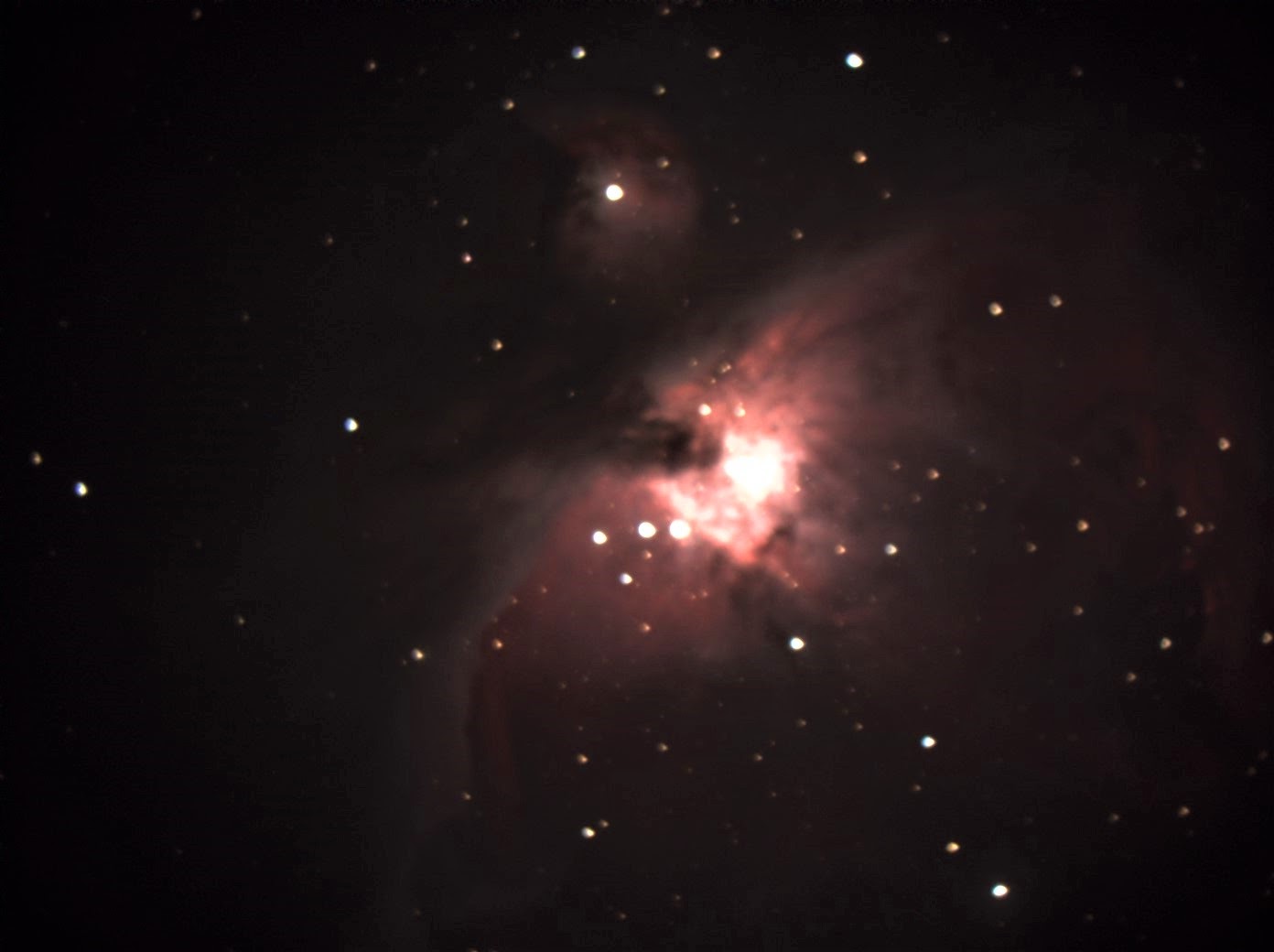
M42 The first object viewed this year was the last one I looked at last year namely the Great Nebula itself.  Of all the deep sky objects on my tour this is the most spectacular and even with a short exposure time the Infinity camera brings out a lot of the structure and colour that fills the field of view.   M43 is the smaller nebula to the north of M42.


NGC 2024


NGC 2024  Large emission nebula similar in size to M42 lies just east of  Alnitak the eastern star of Orion's belt. Ultraviolet light from the star causes the nebula to emit light. A cluster of young stars apparently lies behind the dark gas and dust obscuring the central regions.  


NGC 1999


NGC 1999  From huge emission nebula just observed this  small 1.5 arc minute reflection nebula is quite a contrast. It surrounds and is lit by the variable star V380 Orionis. The dark patch in the center is now believed to be a hole in the cloud rather than dark material. This is my first observation of this object.  

NGC 1788 Another reflection nebula surrounding some tenth magnitude stars and is rather faint on my image.


NGC 1973

                                                                                                                                                                                      NGC 1973 Large reflection nebula to north of M42. Rather nice blue colour. The darker lanes bisecting the nebula form the well known "Running Man" feature.    
This brings my Grand Tour total to 117 objects.


December 31, 2020

#13 Review Of The Year

 31st December 2020

 So as this year of the plague draws to a close I thought I would look back at one of its more positive aspects. For me this was getting back out under the stars and doing some observing. The Grand Tour Project was created as motivation to get out though my initial plan of it taking two years was over ambitious. The observation of Perseus open cluster NGC 1513 ended this years observing run which had started 111 objects earlier with the giant elliptical galaxy M86 in Virgo on the 11th May. These early observations were done at a rush just ticking objects of the list rather than doing them justice. Later on I decided to take more time with each object and find out more about each of them.

  As a comet fan the highlight of the year was without question Comet C/2020 F3 Neowise. A bright naked eye comet reaching above magnitude 1  and visible from suburban skies occurs maybe once every decade. This one also looked like most peoples idea of a comet with a long sweeping tail. Other highlights include the bright Supernova in M61 and getting a look at Mars during this favourable apparition.

 Every year I am going to pick ten objects from my observations to return to sometime and have a closer look. These will be objects that have either intrigued me or surprised me or maybe I have just taken a fancy to. This year I have selected the following:

NGC 1275 and the Perseus Galaxy Cluster. Vast group of galaxies in one field of view, awe inspiring.

NGC 520  This pair of colliding galaxies in Pisces looks unusual even on my small image. 

NGC 891  Impressive perfectly edge on spiral galaxy in Andromeda.

NGC 7662 Blue Snowball Planetary Nebula Andromeda. Surprising amount of detail on small image.

M33 Local Group spiral galaxy. Amazing star clouds. Want to take a more detailed image.

NGC 7320 and Stephans Quintet.  Just dots on my image. 

NGC 7479  Beautiful barred spiral in Pegasus.

NGC 6819 Surprisingly rich open cluster in Cygnus.

NGC 6631 Could not quite work out where this Scutum cluster started or finished.

NGC 6857 I need to have another look at this Cygnus Planetary Nebula.

   Although I prefer visual observing my light polluted skies do not allow proper dark adaption to see faint objects. This year I  acquired an Atik Infinity colour video camera so I can view faint objects "live" on a laptop screen. This camera has made a big improvement to my observing and I hope to do a review of it sometime.

  Writing this blog was inspired by  "Uncle" Rod Mollise' astro blog which I have followed for a long time. Like "Unk" I have made an effort to observe the Orion Nebula M42 every Christmas Eve and this year despite being swamped by moonlight I got a nice view with my 4" f5 refractor.  With direct vision the Great Nebula looked red in colour but with averted vision this effect disappeared. A little more magnification separated the quartet of stars at the heart of the nebula.  As I packed the telescope away Leo  and the realm of the galaxies were rising in the east where the Grand Tour began in the Spring.  It was a nice way to round off the year.


M42

  So what are my plans for next year? There are a number of variable stars on the tour that I would like to follow over the year and there are also a lot of double stars to look at. Other than Mars I did not do much planet observing this year so I hope to do more. Otherwise I will carry on tracking down objects on the list and hopefully enjoy it as much as I did this year.

December 30, 2020

#12 Seeing Double

 20/12/2020

   Up to now on The Grand Tour I have only observed one double star; and that was an all to superficial glance at the showpiece double Beta Cygni. There are in fact 89 doubles on the list so tonight I decided it was time to hunt down a few more starting with three in Aries. All observed visually with the 8" SCT  f10 x210.

Gamma Arietis   Both components are magnitude 4.8  and separated by 8".  Both appear white with maybe a hint of yellow

Lambda Arietis  Separated by 37" with components of magnitude 4.9 and 7.7. The primary is a golden yellow colour and to me the secondary has a lavender blue tint.

1 Arietis   Very widely separated by about 3'  and magnitudes 6.2 and 7.4.  The primary has  a golden yellow tint and the secondary white / blue but the colours are not so obvious as Lamda just observed. 

.   A quick trip to Andromeda now with my wide field eyepiece x60 to observe Open Cluster               NGC 752  At 50' across this large cluster fills the field of view. The brightest star on view is orange and terminates the southern end. A white double terminates the northern end. The main body of the cluster sprawls out between these and is moderately rich. No fainter stars are hinted at with averted vision.

 The Infinity video camera was now attached for some galaxy hunting.

NGC 672  Spiral galaxy in Triangulum with what appears to be a diffuse elongated core. Forms a nice group with at least two other galaxies rather like the Leo triplet but fainter.
NGC 925  Barred spiral galaxy also in Triangulum. Elongated and also has a diffuse, spread out central area. Faint spiral arms are visible. A bright spot near the centre is, I guess, a foreground star.

   I never associated Perseus with galaxies but two rather fine ones make my list.

NGC 1275 and Perseus Galaxy Cluster
 NGC 1275  Magnitude 12 galaxy classed as peculiar but appears like an elliptical with a bright core. Brightest member of compact cluster of galaxies with at least 10 in the field of view. Apparently the closest super cluster  to Virgo.
NGC 1023  Magnitude 9.4 elliptical galaxy with a very impressive, bright core.

 Staying in Perseus for two fine Open Clusters.


NGC 1245

 NGC 1245  Very rich in relatively faint stars and fairly compressed. Has chains of stars curving away from centre rather like a loose globular.
 NGC 1513  Rich group of stars of varying magnitudes elongated north to south.


 To finish of the evening I had another look at Comet M3 Atlas.


Comet M3 Atlas

Well condensed nucleus with tail fading away to north - east. Around magnitude 10.

December 25, 2020

# 11 Grand Tour: 102 down 399 to go.

 19th December 2020

   A gap in the clouds allowed me to observe seven more objects starting with 3 galaxies in Cetus. 8" SCT f3.3 and Infinity camera.

NGC 584

 NGC 584 Elliptical galaxy orientated about 15' x 15' with a relatively large bright core. A star lies close to the southern edge of the nucleus. NGC 584, a spiral galaxy, is seen to the west.                                    NGC 936  Barred Spiral Galaxy with a bright nucleus. Almost edge on aligned east - west along the long axis. A fainter galaxy lies 13' to the west.          NGC 1052  Similar to NGC 936 but has an even brighter core region. About 45 degrees inclined and elongated NW - SE  12" x 15".  

 At this point a bank of cloud rolled in.


M76

   With the cloud rolling away to the east I headed up to Perseus which was overhead.

M76  A Planetary Nebula known as "The Little Dumbbell "  Does indeed resemble its larger namesake in Vulpecula but is rather more rectangular. Has prismatic colours either end and is aligned NE - SW. The magnitude 16 central star is not visible. This object lies in a rich field and looks like its "floating" in space.


NGC 869 and NGC 864

 NGC 869  Is the western component of the  well known naked eye double cluster along with NGC  864 to the east.  Both only just fit in the field of view. Always an amazing sight. A couple of orange stars lie between the clusters.

NGC 957 An open cluster not far from the Double Cluster.  Magnitude 7.6 and quite rich elongated E-W 20" x 8" . The brighter stars across the cluster give the impression of being foreground stars.

  Looking up after this observation a bank of cloud rolled in from the west ending the evenings session.


December 19, 2020

#10 A Ghost and a Snowball.

 12th December 2020

      After a lengthy spell of cloudy skies a clear spell on this Saturday evening got me setting the 'scope up before the forecast rain clouds rolled in. I wanted to get a look at comet Atlas in Auriga but first tracked down nine more objects on my Grand Tour 501 list. All observed with the 8" SCT f3.3 and Infinity video camera.

M74

    Pisces contains 9 objects on the GT501, 5 of which are double stars and 4 are galaxies.
 M74 is a face on spiral galaxy some 30 million ly distant. At magnitude 10 it should be easy to see visually but as its light is spread out over 10' x 10' it can be difficult in light polluted skies. The spiral arms are visible on my image and I wondered if the star near the nucleus was a supernova as this galaxy has had three in the last twenty years!           NGC 488 is a near face on spiral galaxy about magnitude 10 and 5' x 4'.  The faint outer spiral arms appear almost like a ring around a compact nucleus.      NGC 524 This lenticular galaxy has a relatively bright well defined nucleus surrounded by faint haze. In a group including an edge on spiral to the west. 3' x 3'. The Hubble image is quite spectacular, rather like looking down a tunnel of light.

NGC 520
 NGC 520  This galaxy was a surprise in as much as it appears more like a ghostly comet than a galaxy. Further investigation reveals it is a highly distorted pair of colliding spirals and is certainly worth a closer look sometime. About magnitude 11 and 4.5' x 2' in size.

 Now I head across to Cetus for another interesting galaxy.

M77  Is a barred spiral galaxy , magnitude 10 and about 8' X 8'.  This is one of the nearest Seyfert Galaxies with an active  black hole in its nucleus.  I can see a very bright nucleus with extensions either side which look like a bar. The spiral  disc is visible with hints of structure.
NGC 404  "Mirach's Ghost"


 Heading up to Andromeda for two contrasting galaxies
.
NGC 404   Only 7' away from magnitude two star Beta Andromeda "Mirach" - which really does look like an orange blazing sun in my image. I assumed by its appearance that this galaxy is a typical giant elliptical. Turns out it is in fact a Dwarf Lenticular Galaxy only 10 million ly away , just beyond our Local Group. It is similar in size to the Small Magellanic Cloud a satellite galaxy of the Milky Way.


NGC 891

  NGC 891   Measuring 14 x 3' this edge on spiral galaxy is an impressive sight. A prominent dark dust lane runs along the midline bisecting the central bulge and disc. About 30 million ly distant and a member of the NGC1023 group. 

 NGC 7662  A Planetary Nebula known as the "Blue Snowball"  . At magnitude 8.6 and about 25" diameter I did not expect to see much structure at the resolution of my set up but on enlarging the image there are some features to be seen. Overall the slightly oval disc is blue-green with an incomplete bright ring structure within. A bright spot at the centre is possibly the magnitude 13 central star.  This nebula is around 3000 ly distant.

NGC 7662
       The 3 stars seen to the top left of the image     range  from  magnitude 14 to magnitude 15.8.

   Aries contains 4 objects on my GT list 3 of which   are double stars. The fourth is magnitude 10.3 spiral   galaxy NGC 772.   The core is very bright compared   to the faint surrounding disc. A slightly brighter   incomplete ring feature seems to be visible around     the edge of this disc which on more detailed images   is revealed as an elongated spiral arm. This galaxy is   interacting with nearby NGC 770 also seen on my   image. This brings my Grand Tour total up to 95.


COMET C/2020 M3 (ATLAS)

I finished of the session with a look at Comet C /2020 M3 (ATLAS) over in Auriga at about magnitude 8.  This comet reached perihelion in late October and passed 0.4AU from the earth. It has a condensed nucleus and tail fading to the north-west.
      

November 26, 2020

#9 Grand Tour : 86 down 415 to go

 14th November 2020

    Despite all my years observing the night sky Lacerta is one of those constellations I never seem  to remember the exact location of. It is however home to a number of interesting deep sky objects and two of its open clusters make my Grand Tour top 500.  Both of these I observed visually with the 8"SCT f10 magnification x62.


NGC 7209  Viewed through intermittent gaps in the clouds, at one point it even started raining, I managed to do a quick and very rough sketch of this open cluster.  The brightest star in view is  magnitude 8 and orange in hue and lies at the north end of the cluster. The cluster stars themselves range from magnitude 9 down and form a kind of U or W shape open to the wsw. Many fainter stars are hinted at with averted vision and this cluster also contains a number of double stars. It is believed to be 3800 ly away and is about 30ly in diameter.


 NGC 7243  Magnitude 6.4 and about 21' in diameter. This open cluster is terminated to the south by a prominent pair of stars and fans out north in a rough V shape. A close double star lies at the mid point with the ssw component being slightly the brighter. There seems to be fewer fainter stars than seen  in  NGC 7209. The cluster is believed to be 2800ly distant. Looking through my records I last observed these two clusters 36 years ago in  November 1984 so I will try and find the sketches I did and compare them with these.


                                                           18th November 2020

   Tonight I thought I would try the Infinity camera with an old camera lens of mine of focal length 135mm f2.8 for some wider angle views. First up I viewed NGC 7000 the North America Nebula which despite its large size just about fitted in the field of view. However I messed up and failed to save the image so will return to it at a later date. I did manage to record the following five Messier Objects.

M39
                                                                                 

     M39   Open Cluster, Cygnus.   About  half a degree in diameter and visible to the naked eye from a dark sight.  Triangular grouping of  around 25 stars in a very rich milky way field. Seems to lie in  a dark relatively starless region in my image though on some other images I have seen  this is not the case. About 624 ly distant and 7 ly in diameter.


M110, M31 and M32.

M110  Dwarf elliptical galaxy, At magnitude 9.0 this is one of the brighter galaxies in the sky but of course is dominated by the neighbouring Andromeda galaxy of which it is a satellite. 23' x 11' in size with a well defined nucleus.                     M31   On the all to rare occasions I have been to a really dark observing site this galaxy is a truly breath taking sight with the naked eye. Spanning 3 x 1 degrees and magnitude 3.4 our closest large galactic neighbour is usually touted as the most distant visible naked eye object, though I think I got a sight of  slightly more distant M33 once. Under suburban skies only the bright nucleus can be seen even with a telescope. The video image brings out some nice detail with some dust lanes being visible. It is now believed to be a barred spiral galaxy like our own with a similar mass but larger in size.     M32 Bright magnitude 8.0 compact dwarf elliptical galaxy.  This satellite of M31  is thought to be the remnant nucleus of a spiral galaxy stripped of its outer disc during interactions with its neighbour. Visually and in the image this is exactly what it looks like and contrasts with M110.  

M33


  M33 The third largest member of the Local Group of galaxies and slightly more distant than M31.  This galaxy is considerably smaller  than the Milky way and  M31 as can be seen in the images. Several spiral arms are visible.

November 16, 2020

#8 Grand Tour: 79 down 422 to go

     Yes 79 + 422 = 501 and the Grand Tour is supposed to be 500 objects.. All will be explained later but first two more observations of Mars.


    This image was taken at 20:40 on the 3rd November. Syrtis Major is the most prominent dark feature extending northwards on the central meridian. The small south polar cap can be seen top right of the image. This is the stage of the martian seasonal cycle when a global dust storm often happens but no sign yet.


  This image was taken exactly one  ( Earth ) day later and Syrtis Major has not quite reached the central meridian demonstrating that a martian day is slightly longer than ours. These images are not as sharp as  I hoped with the seeing being slightly better than before, maybe I need to collimate the telescope optics.


     On the 4th November I observed ten more objects for the Grand Tour Project the first two in Aquarius.

M2  Certainly one of the best globular clusters visible from the northern hemisphere. 55,000 ly distant and 175 ly in diameter with an age of 13 billion years this is one of the oldest and largest globulars. The brightest stars are of the 13th magnitude and many fainter ones surround the bright core. This cluster is apparently a member of the "Gaia Sausage" the remains of a dwarf galaxy merged with the milky way.


    NGC 7009  The "Saturn Nebula" is a magnitude 8 planetary nebula discovered by William Herschel in 1782. Blue green oval with narrow ansae extending either side of the long axis which do indeed resemble saturns edge on rings. A lot of these small planetaries deserve a closer look with more magnification as they can show a lot of structure not seen at this scale.


NGC 7814

             We're heading to Pegasus now for the next eight objects.

   NGC 7814   Edge on spiral galaxy with bright central bulge and prominent dark dust lane bisecting the mid plane. Known as the "Little Sombrero" Dimensions are given as 5.5' x 2.3' and is about 40 million light years distant.

   M15  Magnitude 6.3 globular cluster similar in size and brightness to M2 . Bright core.

  NGC 7217  SAB near face on spiral galaxy. Magnitude 11 and 4' x 3' in size. The  image shows a bright nucleus surrounded by an oval haze.  This galaxy is unusual for having a population of stars that rotate in the opposite direction to the majority.


NGC 7320 & Stephan's Quintet
  NGC 7320  SA spiral galaxy, magnitude 13, 2'x1' in size.  A member of "Stephan's Quintet" though at a distance of 40 million ly is much closer than the other 4 at 300 million ly. On my image it is the oval smudge to the right of the interacting pair NGC 7318 A&B at the centre.  Magnitude 14 galaxies NGC 7319 and 7317 complete the group. I have been wanting to  observe this famous group for some time so its good to track it down at last, albeit with a  video camera.
   NGC 7321  My next object was supposed to be NGC 7331 but entered 7321 into the GOTO by mistake, but I am going to include it in the GT project anyway. Turns out the small oval smudge on my screen is a magnitude 13 barred spiral galaxy. This galaxy was host to a supernova in 2013.

NGC 7331 and friends.


  NGC 7331   This magnitude 10 spiral galaxy  has a bright core  and prominent dust lanes  and lies at an oblique angle to us. At a distance of 40 Mly  it  lies in the foreground of a more distant grouping of galaxies NGCs 7335.7336.7337 and 7340 seen to the left of 7331 in my image/. NGC 7320 just observed is close  by in the sky and at the same distance so the two may be associated.


NGC 7479

    NGC 7479  We all love a barred spiral galaxy and this magnitude11 example is one of the best. It is classified as a seyfert galaxy undergoing starburst and has a relatively small bright core. 

   NGC 7619  Small round  fuzzball  on my image and in same field of view as several other members of the Pegasus 1 galaxy group including NGCs 7626, 7631, 7623 and7611.  Would be interesting to take a deeper exposure of this cluster as many faint galaxies are just about visible.


October 30, 2020

MARS

   Mars reached opposition on October 13th and is well placed in the late evening sky. This apparition is in fact the best for northern hemisphere observers for some time so it was about time I took a look. On October 26th at 20:05 UT using the 8" SCT at X150 it was immediately apparent the atmospheric seeing conditions were very poor. I could just about make out the small South Polar Cap and some dusky markings across the centre of the disc.


 On October 28th I decided to try imaging Mars with my Phillips webcam which I hadn't used for a very long time. Planetary imaging cameras have improved a lot since webcams were a popular choice but I am not ready for another new camera --yet!  I used the 8"SCT at f30 and tried Sharpcap imaging software for the first time. The quivering disc of the planet was soon located on the webcams small chip and after the usual struggle to focus the image I was ready to go. With the seeing poor again I only recorded about 400 frames of video file and packed the equipment away. Next day I processed the video file in Registax using the "best" 140 frames of the 400 which resulted in the image shown. Well I am pleased with my first attempt at planetary imaging for a long time even if it doesn't compare to what can be achieved these days. I am certainly going to continue imaging Mars this apparition and maybe some of the other planets to.

  For comparison I have downloaded a computer generated image of Mars disc for the same date and time.

October 09, 2020

#6 A SOUTHERN GEM

 21st September 2020

      Sagittarius' many wonders are usually hidden by buildings from my location but a gap in the houses allows me seek out one or two now and then. NGC 6818 is a Planetary Nebula that lies in the northern part of the constellation and is known as the "Little Gem". Visually at x78 this appears like a well defined out of focus magnitude 8 star. No structure is visible but there is a hint of blue colour.

NGC 6819

 Back up north now to Cygnus with the video camera and 8" SCT.

NGC 6811 Well defined and fairly large Open Cluster in rich field. About 30 bright stars in a circular grouping.

NGC 6819  A smaller more compact Open Cluster the brightest stars of which are formed into two lines. Many fainter stars surround these. Certainly worth having a closer look sometime.

NGC 6866  Slightly larger Open Cluster than 6819 but more sparse and fewer fainter stars. Main group of brighter stars elongated north - south with lesser chains going east- west.


M29

M29 The brightest stars of this Open Cluster form a surprisingly similar pattern to NGC 6819 just observed. However there are far fewer fainter stars and even larger telescopes do not reveal many more. 

October 03, 2020

#5 Grand Tour Project : 63 down, 437 to go.

     August proved to be a cloudy month with very limited opportunities for observing. However two clear but hazy nights on the 13th and 14th September got the project rolling again with 23 objects observed including some gems. All observed with 8" SCT f3 and Atik Infinity camera.


  M13  Spectacular bright globular cluster in Hercules. Well resolved core with the dark "propeller" feature visible.

M92 Impressive globular cluster with a bright condensed core with extensive halo of faint stars.

NGC 6229 The third globular in Hercules is much smaller than the previous two but has a very bright core. Its outer star lanes are well resolved.

NGC 6210 At the image scale of the camera this small ( 16") planetary nebula appears like a bright star. Only its blue tint gives it away.


Ophiuchus is mostly hidden by the garage but I manage to image three of its brightest globular clusters.

M10 A large globular resolved to core from which loose chains of stars stretch away.

M12 Similar size to M10 but looser and resolved easily to core

M14 Smaller than other two but still impressive. fairly condensed and round. Many faint stars surround core


M57
M57
Over to Lyra now for its two Messier objects.
M57 The haunting Ring Nebula. This was the first deep sky object I viewed through a telescope 40 years ago and I have made the effort to seek it out every year since. The video camera shows how colourful it is with a spectrum from red outer edge through yellow to green on the rings inner edge. The central "star" is also seen on the image.
M56 Globular Cluster. Well resolved to core, fairly loose .
 
South to Vulpecula for another Messier classic.


M27
M27
M27 Planetary Nebula. Large and bright. Red and green colours evident and outer lobes just visible on image.
NGC 6800  Large Open Cluster with a number of prominent stars but not concentrated.
ALBIREO Beta Cygni. One of the best known double stars. Colours more prominent visually but primary star has obvious orange hue.


NGC 6910

NGC 6910 Open Cluster Cygnus. A personal favourite of mine. A string of magnitude 9/10 stars between two magnitude 7 yellowish stars. A scattering of fainter stars including a number of doubles complete this pleasing little cluster.


                                                         14th SEPTEMBER 2020

 Another hazy but cloudless night. Again the video camera coupled with the 8" SCT f3.3 performed well in the poor visibility.

  M11

M11 Open Cluster, Scutum.  One of the richest clusters almost like loose globular. Stands out well in rich field.

M26 Open Cluster, Scutum. Similar size to M11 but less rich. Four of the brightest stars make up a kite shape at the centre one of which is a close equal double. A scattering of fainter stars blend into the rich field.

NGC 6631 Open Cluster, Scutum. The centre of this cluster seems to be marked by three orange stars in a triangle but otherwise does not stand out in a rich field. I could not find much information about this cluster, it seems to be a bit neglected. The DSS image does not clearly show its extent but gives its diameter as 6'. 

NGC6781 Planetary Nebula, Aquila. Large ( 100") annular ring, red in colour. Faint star seen at centre but not sure if this a field star. Not seen this one before.

M71  Globular Cluster, Sagitta.  Once thought to be an open cluster but now reclassified as a small, loose globular. Seems to consist of many faint stars of similar magnitude. A number of brighter stars across the face of the cluster I suspect are foreground stars. 

NGC 6891 Planetary Nebula, Delphinus.  Small, at this image scale only its blue colour distinguishes it from the stars.

NGC 6905

NGC 6905 Planetary Nebula, Delphinus. "Blue Flash Nebula" Bright, annular with obvious blue colour. Central "star" or nuclear region very bright relative to nebula. Oval ring has dark areas to north and south.

NGC 6934 Globular Cluster, Delphinus. Small but well resolved. Has intriguing dark areas in the central region.

NGC 6826 Planetary Nebula, Cygnus. The "Blinking Planetary" is the brightest object in the field of view at magnitude 7. Has a magnitude 10 central star but is lost in the over exposed nebula. Blue colour.


NGC 6857


 NGC 6857 HII Nebula, Cygnus. Pleasing red nebula   surrounding relatively bright star. A couple of  small,   fainter, red nebulous areas are in the field of view.

 NGC 6888 HII Nebula, Cygnus.  Very large, red, crescent   shaped nebula in rich star field. Much detail seen but   deserves better viewing conditions.